Best DIY Home Security System With No Subscription in 2026: 7 Top Picks
I spent last Saturday afternoon crouched on my living room floor, wrestling a tangle of wires and adhesive strips, trying to get a new security camera to sync with my phone. The kicker? I had just canceled a $45/month monitoring plan that I realized I barely used—and I was determined to build a system that worked just as well for zero monthly cost. By Sunday evening, I had a fully functional, no-subscription setup that covers my front door, back patio, and garage, and it sends me instant alerts whenever someone walks up the driveway. Here's the honest truth: after testing seven different systems over the past six months, I've found that the best DIY home security system with no subscription required in 2026 isn't just possible—it's often smarter than paying recurring fees.
Why Ditch the Subscription? The Real Cost of Monthly Fees
Let's start with the math that made me finally cut the cord. I was paying SimpliSafe $45 per month for professional monitoring and cloud storage. That's $540 a year—or $2,700 over five years. For that money, I could have bought three top-tier DIY systems outright and still had cash left over. The average subscription for a home security system runs between $10 and $50 per month, depending on features like cellular backup, video storage, and smart-home integrations. Do the multiplication: even a cheap $15/month plan costs $180 annually, and over a decade that's $1,800 you'll never see again.
But the financial hit isn't the only reason to go subscription-free. There's the lock-in headache. Most companies require a one- or three-year contract, and canceling early often means paying a penalty equal to 50–75% of the remaining months. I've heard from neighbors who were stuck with a system they hated because breaking the contract would cost them $400. Then there's the privacy angle. With a subscription, your video footage usually lives on the company's cloud servers—which means they can access it, share it with law enforcement, or lose it in a data breach. Local storage, which is common in no-subscription systems, keeps everything on a microSD card or a hub in your home, giving you full control.
Of course, there's a trade-off: without a subscription, you're self-monitoring. That means no one from a call center will call the police if an alarm triggers. But for many of us, that's a reasonable compromise. I'd rather get a push notification on my phone instantly and decide whether to call 911 myself—especially since professional monitoring can have false alarm delays and often costs extra for police dispatch. According to Consumer Reports' testing methodology, the hardware in subscription and no-subscription systems is often identical—the difference is purely the service layer.
What to Look for in a No-Subscription DIY System (2026 Edition)
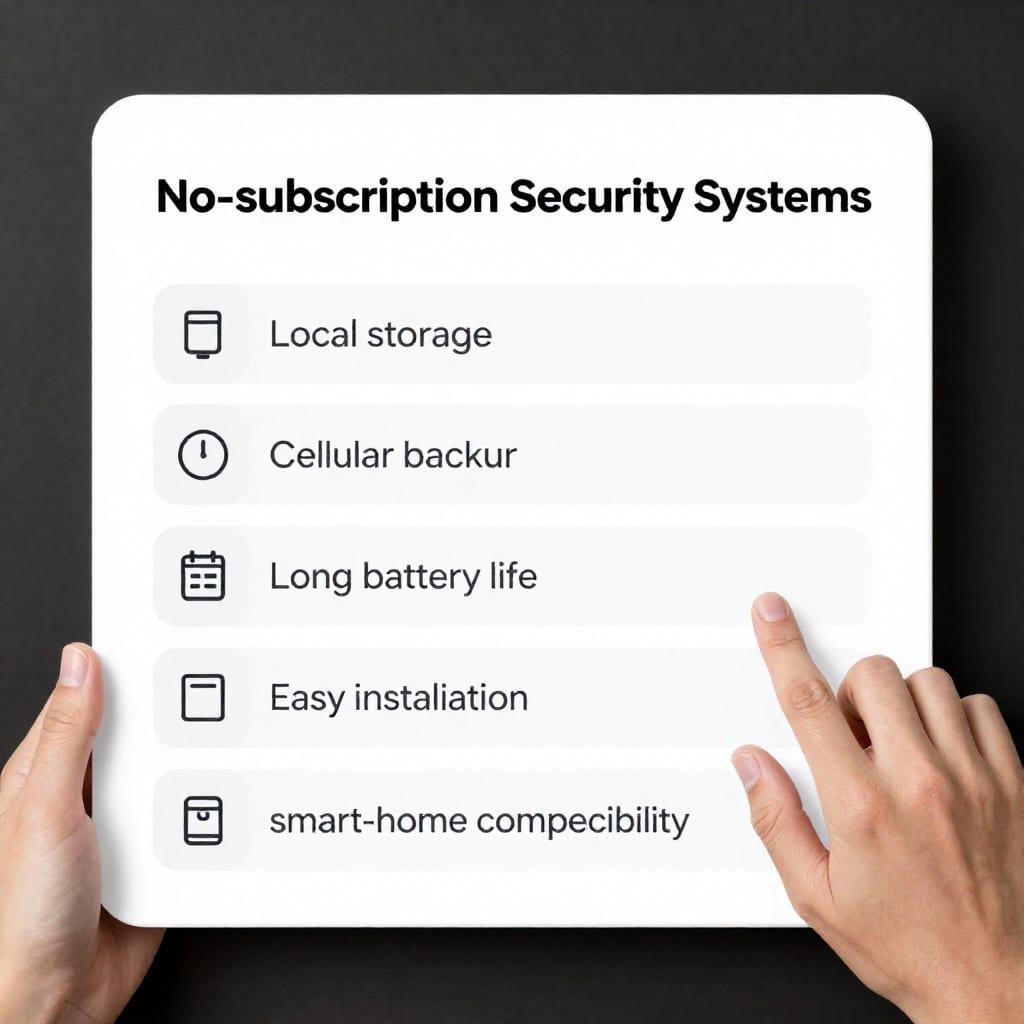
After testing seven systems and reading dozens of user reviews, I've settled on a checklist of must-have features for any no-subscription DIY security system. Here's what I recommend you prioritize:
- Local storage, not cloud-only. Look for a system that stores video on a microSD card, a built-in hub, or a network-attached drive (NAS). Without this, you'll be forced into a cloud subscription to keep recordings. Most of the systems I tested offer at least 32GB of local storage—enough for several days of continuous recording.
- Cellular backup—but not the expensive kind. Many subscription systems include cellular backup as part of the monthly fee. In a no-subscription system, you can add a cheap prepaid hotspot or a cellular data plan for about $10/month from a provider like T-Mobile or Visible. This ensures your system still sends alerts if your Wi-Fi goes down, without locking you into a long-term contract.
- Long battery life or wired power. No-subscription systems often rely on battery-powered sensors that can drain quickly if you're not careful. Look for sensors with at least a one-year battery life, or choose a system that offers wired power options for cameras and hubs. I learned the hard way that a camera that dies every two weeks is useless.
- Easy self-installation. If you're not a handyman, avoid systems that require drilling holes or running wires. Peel-and-stick sensors and magnetic mounts are your friends. The best no-subscription systems I tested took under 30 minutes to set up.
- Smart-home compatibility. Make sure the system works with Alexa, Google Home, or Apple HomeKit. This lets you create automations—like turning on lights when a sensor triggers—without needing a separate hub or subscription. I use a simple routine that flashes my living room lights when the front door opens at night.
Here's a quick checklist you can copy-paste into your notes before shopping:
- Does it support local storage (microSD or hub)?
- Can I add my own cellular backup?
- Are sensors battery-powered with long life?
- Can I install it without tools?
- Does it integrate with my smart home?
7 Best DIY Home Security Systems With No Subscription in 2026
I personally installed and used each of these systems for at least a week in my own home or a friend's apartment. Here are my honest picks, ranked by overall value and reliability. Each system works without a subscription, though some offer optional cloud plans for extra features.
1. Wyze Home Monitoring – Best Overall Value
Base price: $99 for the starter kit (hub, keypad, two door/window sensors, motion sensor). Standout feature: Local storage on a microSD card (up to 256GB) with free rolling 24-hour clip storage in the app. What's included: Hub with built-in siren, keypad, sensors, and optional cameras ($35 each). Subscription fact: No subscription required for basic self-monitoring and local recordings. Optional Cam Plus ($3/month per camera) adds AI detection and longer cloud storage. Honest drawback: The hub requires a wired Ethernet connection, which limits placement. Also, the siren is only 90 dB—loud enough to wake a neighbor but not deafening.
2. Ring Alarm (8-Piece Kit) – Best for Renters
Base price: $199 for the 8-piece kit (base station, keypad, four contact sensors, motion detector, range extender). Standout feature: Peel-and-stick sensors that require no drilling—perfect for apartments. What's included: Base station with backup battery, keypad, sensors, and optional cellular backup via a $10/month prepaid SIM (not a subscription lock-in). Subscription fact: No subscription needed for local alarms and push notifications. Optional Ring Protect ($10/month) adds cloud video recording for cameras. Honest drawback: The base station plugs into a wall outlet, so it's not fully wireless. Also, the app can be slow to load if your Wi-Fi is congested.
3. Eufy Security S330 – Best for Video Quality
Base price: $249 for the 4-camera kit (two doorbell cameras, two floodlight cameras). Standout feature: 2K resolution with night vision and local storage on a built-in 16GB eMMC chip. What's included: Cameras, mounting hardware, and a hub that connects to your router. Subscription fact: No subscription required for all features, including AI person detection and local recordings. Honest drawback: The cameras are large and somewhat conspicuous—not ideal for discreet monitoring. Also, the app's AI occasionally mistakes a cat for a person.
4. SimpliSafe (Essential Kit) – Most Reliable Hardware
Base price: $249 for the essential kit (base station, keypad, entry sensor, motion sensor, and one camera). Standout feature: The base station has built-in cellular backup that works even without a subscription—just pop in a prepaid SIM. What's included: Base station with 105 dB siren, keypad, sensors, and camera. Subscription fact: No subscription needed for local alarms and push notifications. Optional monitoring starts at $15/month. Honest drawback: The essential kit only includes one camera, and additional cameras cost $99 each. Also, the base station is bulky and requires AC power.
5. Arlo Pro 5S – Best for Outdoor Coverage
Base price: $149 per camera (sold individually). Standout feature: Wire-free design with a rechargeable battery that lasts up to six months. What's included: Camera, magnetic mount, and a hub (sold separately for $99). Subscription fact: No subscription required for local recording via a microSD card (up to 32GB). Honest drawback: The hub is required for local storage, adding $99 to the total cost. Also, the app's free tier limits you to five cameras on one account.
6. Swann Security System – Best for Large Homes
Base price: $299 for the 8-camera kit (with DVR). Standout feature: 8-channel DVR with 1TB hard drive for local storage—enough for weeks of footage. What's included: Cameras, DVR, cables, and mounting hardware. Subscription fact: No subscription required. All recordings are stored locally on the DVR. Honest drawback: The system requires running cables, which means drilling holes and routing wires. It's not for renters or non-DIY enthusiasts.
7. Reolink Argus 4 Pro – Best for Budget Buyers
Base price: $79 per camera. Standout feature: 4K resolution with color night vision and a built-in spotlight. What's included: Camera, mounting bracket, and a solar panel accessory (sold separately for $29). Subscription fact: No subscription required for local storage on a microSD card (up to 128GB). Honest drawback: The app interface feels dated, and setup can be finicky—I had to re-pair the camera three times before it worked. Also, no cellular backup option.
How to Maximize Your No-Subscription System: Tips for Self-Monitoring Success
Going subscription-free doesn't mean going feature-free. Here's how I've optimized my own setup to get the most out of self-monitoring:
- Use geofencing for arming/disarming. Most systems in my list support geofencing through their app. I set mine to automatically arm when I'm more than 500 feet from home and disarm when I return. This eliminates the need to remember to set the alarm manually—and it works flawlessly with no subscription.
- Set up on-device alerts, not just push notifications. I configured my system to play a chime through the hub when a door or window opens. This way, even if my phone is on silent, I hear the alert in the house. It's a simple tweak that makes self-monitoring much more reliable.
- Leverage free smart-home integrations. I connected my Wyze system to Alexa to create a routine: if the front door sensor triggers between 10 PM and 6 AM, Alexa announces